

Medical Aesthetics
Selphyller Gel vs EZ Gel: Which Plasma Gel Is the Better Under-Eye Filler?
Medically Reviewed by Emily Dawson, DHA, MBA, MSN, RN10 min read
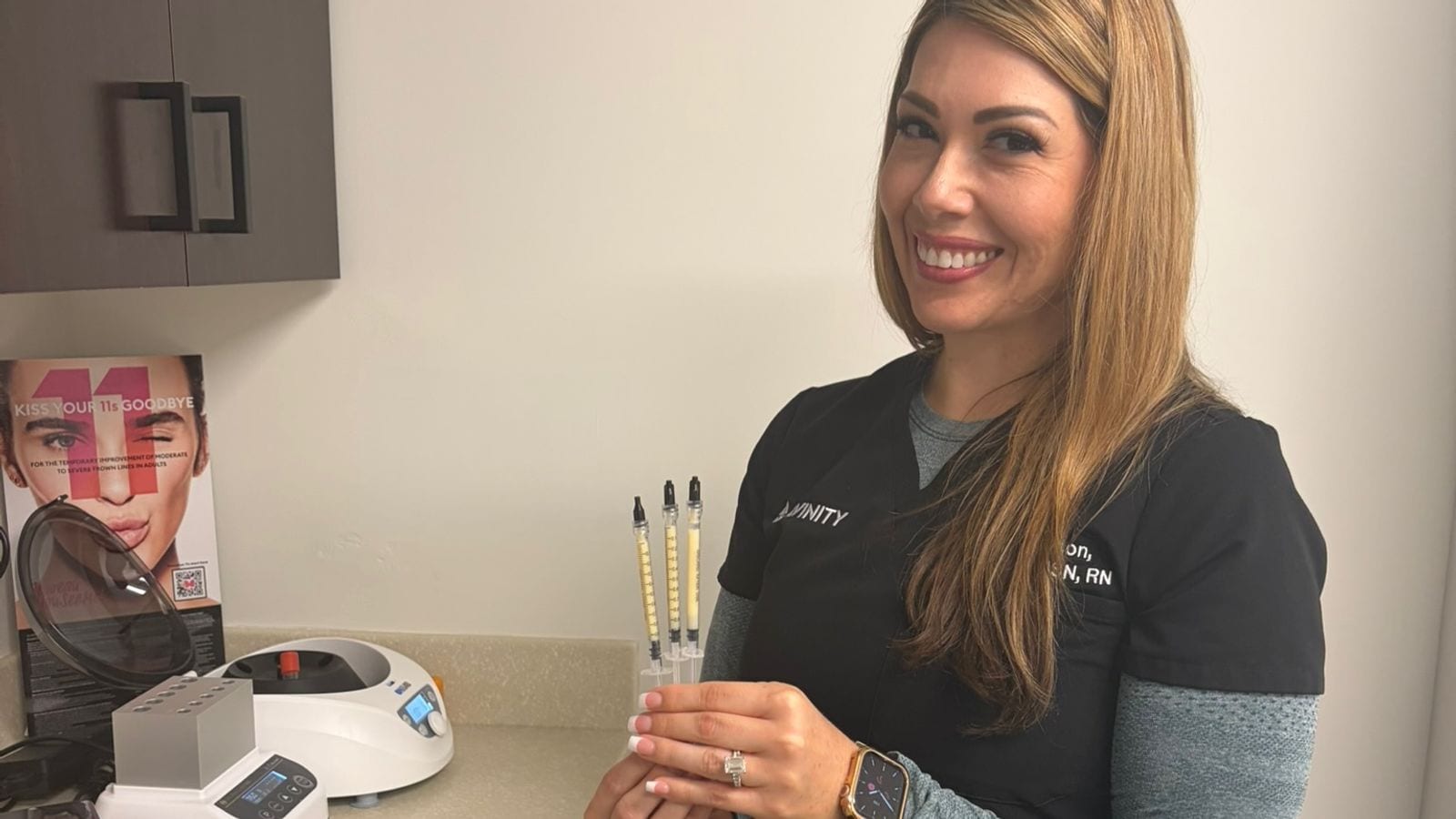
If you have been researching a plasma gel filler made from your own blood as a natural filler alternative, you have probably run into both names. Some clinics use them interchangeably. A few even list “Selphyller Gel (EZ Gel)” on the same page as if they were one product. They are not. Selphyller Gel and EZ Gel start from the same blood draw and end up in very different syringes, and the difference matters for how long your results last, what is actually doing the work under your skin, and how the product is regulated.
This is a plain comparison of Selphyller Gel vs EZ Gel: how each is made, where they overlap, where they diverge, and which one we chose to offer at Avinity in Scottsdale and why.
The short answer
Both products are plasma gel fillers, sometimes called bio fillers. Both are made in the treatment room from a small sample of your own blood, with nothing synthetic added, and injected to restore volume and stimulate collagen in areas like the under-eyes, nasolabial folds, cheeks, and lips.
The difference is what goes into the gel.
Selphyller Gel is made from platelet-rich fibrin matrix, or PRFM, prepared in the FDA-cleared Selphyl PRFM system and converted to a gel with a brief, controlled heating step. The platelets, fibrin, and growth factors are the entire product. Nothing is added and nothing is diluted.
EZ Gel (sold as ezGEL by CosmoFrance, and often marketed by clinics as PRF EZ Gel) is made mostly from platelet-poor plasma that has been heated to about 75°C (167°F) so the albumin protein in it unfolds and sets into a gel. That heated albumin gel is then mixed two-to-one with a smaller portion of platelet-rich fibrin. The bulk of the volume comes from cooked albumin. The platelets are the minority ingredient.
Put simply: Selphyller Gel is made only from the platelet-rich part of your blood with no added albumin, while EZ Gel is mostly heated albumin with a smaller amount of platelet-rich fibrin mixed in.
Selphyller Gel vs EZ Gel at a glance
| Selphyller Gel | EZ Gel (ezGEL) | |
|---|---|---|
| Source | Your own blood | Your own blood |
| Active material | Platelet-rich fibrin matrix (PRFM), 100% of the gel | About 1/3 platelet-rich fibrin, about 2/3 heat-set albumin from platelet-poor plasma |
| Preparation | Centrifuge in the Selphyl closed system, form the fibrin matrix, brief controlled heat | Centrifuge, separate platelet-poor plasma, heat to about 75°C, cool, mix 2:1 with PRF |
| Chair time for prep | About 20 to 30 minutes | About 45 to 60 minutes |
| Preparation system | FDA-cleared Selphyl PRFM system | Tubes registered with the FDA as Class I blood collection devices; the heating step is a clinical technique, not a cleared indication |
| Manufacturer longevity data | None published; providers commonly report 12 to 18 months | None published ("working on longevity studies"); providers commonly report 4 to 6 months for volume |
| Typical sessions | Often 1 to 2 | Usually a series of 2 to 3 |
| Common areas | Under-eyes, nasolabial folds, marionette lines, cheeks, lips, acne scars, hands | Same |
| Downtime | Swelling and bruising for 2 to 3 days | Same |
What they have in common
Before getting into differences, it is worth being fair about how much these two share, because the overlap is real.
Both are made entirely from your own blood. Everything injected came out of your arm twenty minutes earlier, which is why allergic reaction and rejection are essentially not a concern with either one. Both are marketed as a natural alternative to hyaluronic acid fillers like Juvederm for people who want a softer result or who have had a bad experience with traditional filler, and patients often search for both under the umbrella term “biofiller.” Both address the same map of the face: under-eye hollows, fine lines, nasolabial folds, marionette lines, cheeks, lips, and acne scarring, and both are sometimes used on the neck and hands.
Both also work in two ways at once. They add volume where they are injected, and they release growth factors from your platelets that tell your skin to build new collagen. Where a hyaluronic acid product is formulated to restore volume, contour, and structural support, both of these deliver a volumizing effect alongside a regenerative one. The collagen response is part of what you are paying for.
And both have the same basic recovery: some swelling, sometimes a bruise, tenderness for two or three days, then you go about your life.
If you stopped reading here, you might reasonably conclude they are the same thing with different branding. They are not, and the reason is in how each one is made.
How each one is made
Selphyller Gel: PRFM first, then gel
The Selphyl process starts with a standard blood draw into a Selphyl tube. The tube is spun in a centrifuge, and a separator gel inside the tube traps red and white blood cells below it, leaving platelet-rich plasma on top. That plasma is transferred within a closed system into a second tube, where the fibrin in your blood forms a three-dimensional matrix around the platelets. This is what makes PRFM different from ordinary PRP: the platelets are held in place in a natural mesh rather than floating free, and Selphyl cites published research showing that fibrin-based platelet preparations release growth factors over roughly seven to ten days rather than in a short burst.
To make Selphyller Gel, that PRFM is then heated briefly under controlled conditions in Selphyl’s dedicated heater, which thickens it into an injectable gel. The whole preparation takes roughly 20 to 30 minutes.
The point to hold onto: the gel is made from the platelet-rich fraction of your blood. The volume and the biology come from the same material.
EZ Gel: heated albumin plus a PRF top-off
This is where the EZ Gel vs PRF confusion starts, because EZ Gel contains PRF but is not simply PRF. ezGEL uses a different strategy. Blood is drawn and spun at low speed. The platelet-rich fibrin concentrate is set aside. The platelet-poor plasma, which is mostly water and albumin, is heated to approximately 75°C (167°F). At that temperature albumin, the main protein in plasma, changes structure and sets into a gel, the same way an egg white turns from clear liquid to solid white when it is cooked. The manufacturer describes this as happening “without any chemical addition.” That is accurate. It is also, in plain terms, cooked protein. The cooking is what makes it firm.
The albumin gel is cooled, then mixed with the PRF concentrate at a ratio of about two parts albumin gel to one part PRF. The manufacturer states the process takes 45 to 60 minutes.
To be clear, the PRF portion of EZ Gel PRF is real platelet-rich fibrin and does carry growth factors. The question is not whether EZ Gel contains the good stuff. It is how much of the syringe is the good stuff, and how much is temporary padding there to give immediate volume.
Where the difference shows up
What is doing the work inside the gel
With Selphyller Gel, the platelets, fibrin, and growth factors are the whole product. The volume you see in the mirror and the collagen stimulation happening underneath are coming from the same material.
With EZ Gel, roughly two-thirds of the volume is heat-set albumin. It gives a visible, immediate result, but albumin gel does not release growth factors. Its job is simply to take up space until your body breaks it down. The skin-improving work is done by the one third that is PRF.
There is also a PRFM vs PRF distinction inside that one-third. Selphyl’s matrix is formed in a closed system with the platelets bound into a cross-linked fibrin scaffold, while the PRF in EZ Gel is prepared with a standard spin. Both release growth factors over days rather than minutes; the matrix is designed to keep them working right where they were injected.
Neither approach is wrong. They are simply optimized for different things. EZ Gel is weighted toward the instant “before and after” photo. Selphyller Gel is weighted toward the biology.
How long results last
This is where you should be skeptical of everyone, including us, so here is how the evidence actually breaks down.
For EZ Gel, provider reports are fairly consistent: the volumizing effect of a single session lasts around four to six months, with some patients seeing nine months to a year. Physicians answering questions on RealSelf describe the gel itself as dissolving within a few weeks, with collagen stimulation continuing afterward. Most clinics recommend a series of two to three sessions. The manufacturer’s website states that longevity studies are still in progress and publishes no duration claim.
For Selphyller Gel, Selphyl’s product page also does not publish a duration figure. Clinics using it commonly report results in the 12 to 18 month range, and some claim longer. Those are provider observations, not trial data, and no head-to-head study of the two products has been published.
What we can say with confidence is what the composition predicts. A product that is entirely platelet-rich fibrin matrix, with growth factors released over about a week, has more regenerative material per syringe than a product that is one-third PRF. It is reasonable to expect that to translate into longer-lasting collagen benefit and fewer required sessions. It is not reasonable to promise you a specific number of months, and we will not.
Regulatory status and safety
The Selphyl PRFM system is FDA cleared. The tubes, the separator gel, and the closed-system transfer were reviewed by the FDA for preparing platelet-rich plasma from a patient’s own blood.
Regulatory Status
EZ Gel's tubes are registered with the FDA as Class I blood collection devices, the same category as the ordinary tubes used to draw blood at a lab. The heating step that turns plasma into a gel is a clinical technique performed by the provider, not a cleared indication of the device. Some physicians consider this distinction important, and there has been open debate in the industry about whether heating blood products falls outside what any device has been cleared to do. Others consider it a formality with no bearing on outcomes. We are describing the status, not accusing anyone of anything. But when two products do broadly the same job and only one was prepared in a system the FDA has reviewed for that purpose, we think you should know which is which.
On day-to-day safety, both are low risk in experienced hands. Expect swelling, possible bruising, and tenderness for two to three days with either product. The under-eye area is technique-sensitive for every injectable, autologous or not, so who is holding the syringe matters more than what is in it.
Time in the chair
Selphyller Gel preparation runs about 20 to 30 minutes in a single closed system. EZ Gel runs about 45 to 60 minutes because the heating and cooling steps are separate. Neither is a long appointment, but if you are combining the treatment with something else, the difference adds up.
At Avinity a visit looks like this: a consultation to confirm the plan, a blood draw, preparation while you relax, topical numbing if you want it, injection, and aftercare instructions. Most patients are in and out in about an hour.
Cost
Neither manufacturer publishes pricing, and most clinics say “it depends” and stop there. We think that is unhelpful.
Pricing depends on the areas treated and the number of sessions recommended. Your consultation includes a clear number before anything begins.
One thing to keep in mind when you compare quotes: EZ Gel is usually sold as a two or three session series. The fair comparison is total cost of treatment, not the price of one appointment.
Who should choose Selphyller Gel
Selphyller Gel treatment at Avinity is the better fit if you want the healing part of your blood, the platelets and growth factors, to be the main treatment rather than a supporting ingredient, if you prefer a product prepared in an FDA-cleared system, if you would rather do fewer sessions, and if your concerns are under-eye hollows, fine lines, early volume loss, or skin quality rather than dramatic reshaping. Plasma gel under the eyes is one of the most requested uses, and it is where the difference in composition matters most, because the tissue is thin and you want the regenerative effect more than bulk.
It is also the better fit if you want the recommendation to come from a clinic that carries more than one tool. Avinity offers Selphyller Gel alongside the Juvederm collection and neurotoxin treatments, so when we recommend a plasma gel filler it is because it is right for your face, not because it is the only thing in the fridge.
When EZ Gel, or something else, might make sense
If your priority is the most visible volume you can get from a single autologous session and you are comfortable with a shorter duration and a series of appointments, EZ Gel is a reasonable product. Plenty of patients are happy with it.
And if you have significant volume loss, a hyaluronic acid filler may simply do a better job than either plasma gel, because HA products are engineered for lift and hold in a way that autologous gels are not. In some cases the honest answer is a surgical consultation. A good provider will tell you that rather than sell you a series of anything.
The bottom line
Selphyller Gel and EZ Gel start from the same tube of blood and end up as different products. Selphyller Gel keeps the platelet-rich fibrin matrix as the entire gel and is prepared in an FDA-cleared system. EZ Gel is mostly heat-set albumin with PRF mixed in, prepared with a technique that sits outside its device clearance. Both can give a good result. But if the reason you are choosing a plasma gel is the regenerative biology, Selphyller Gel puts more of that biology in the syringe, and that is why it is the one we offer at Avinity.
If you are still weighing treatment categories rather than plasma gel brands, our comparison of Botox and dermal fillers covers when a hyaluronic acid product is the better tool, and RF microneedling versus traditional microneedling explains how we evaluate a device before adding it. When you are ready, you can book a consultation.
This article is for educational purposes and is not a substitute for a consultation with a qualified provider. Individual results vary.
Sources
-
Selphyl. Selphyller Gel product page.
-
Kobayashi E, Flückiger L, Fujioka-Kobayashi M, et al. Comparative release of growth factors from PRP, PRF, and advanced-PRF. Clinical Oral Investigations. 2016;20(9):2353-2360. PMID 26809431. This is the study Selphyl cites for sustained release. It compares generic PRP and PRF preparations over 10 days, not the Selphyl device specifically, and the wording in this article reflects that.
-
CosmoFrance. ezGEL: Autologous Bio-stimulating Serum. The 75°C process, the 2:1 ratio, and the statement that longevity studies are in progress.
-
U.S. Food and Drug Administration. Entry for the Selphyl Autologous Fibrin and Platelet System in the Establishment Registration and Device Listing database.
-
U.S. Food and Drug Administration. Entry for ezGEL in the Establishment Registration and Device Listing database, listed by CosmoFrance under product code KST, a Class I vacuum-assisted manual blood collection system.