

Research & Evidence
Botox and Mood: Could Botox Do More Than Smooth Wrinkles?
By Emily Dawson, DHA, MBA, MSN, RN, Executive Director, Avinity Health6 min read

Most people know Botox for softening wrinkles and creating a more refreshed appearance. Over the past two decades, though, scientists have been investigating something more surprising: whether relaxing certain facial muscles can also influence how we feel. A growing body of research on Botox and mood suggests the connection may be real.
The Short Answer
The connection between Botox and mood is a genuine, active area of research. Multiple randomized trials suggest that relaxing the frown muscles may ease depressive symptoms through the facial feedback loop. The evidence is promising but not conclusive, and Botox is not FDA approved to treat depression.
This article looks at what the science actually says, and what it does not. If you are simply exploring Botox in Scottsdale for wrinkle prevention, that remains the most common and well established reason to consider treatment. The mood research is an emerging bonus question, not the reason to book.
The Facial Feedback Hypothesis
More than 100 years ago, Charles Darwin, and later the psychologist William James, proposed a striking idea: our facial expressions do not simply reflect our emotions, they may actually help shape them. This concept is known as the facial feedback hypothesis.
Consider smiling. We smile because we are happy, but research has shown that the act of smiling can itself enhance positive emotions. Researchers wondered whether the reverse might also be true.
The muscles between the eyebrows, the corrugator and procerus muscles, create the expression we associate with stress, worry, anger, and frustration. Every time these muscles contract, they send signals back to the brain, including areas involved in emotional processing such as the amygdala.
Botox temporarily relaxes these muscles so they cannot contract as strongly. Researchers believe this may reduce the negative facial feedback sent to the brain, potentially influencing how emotions are processed.
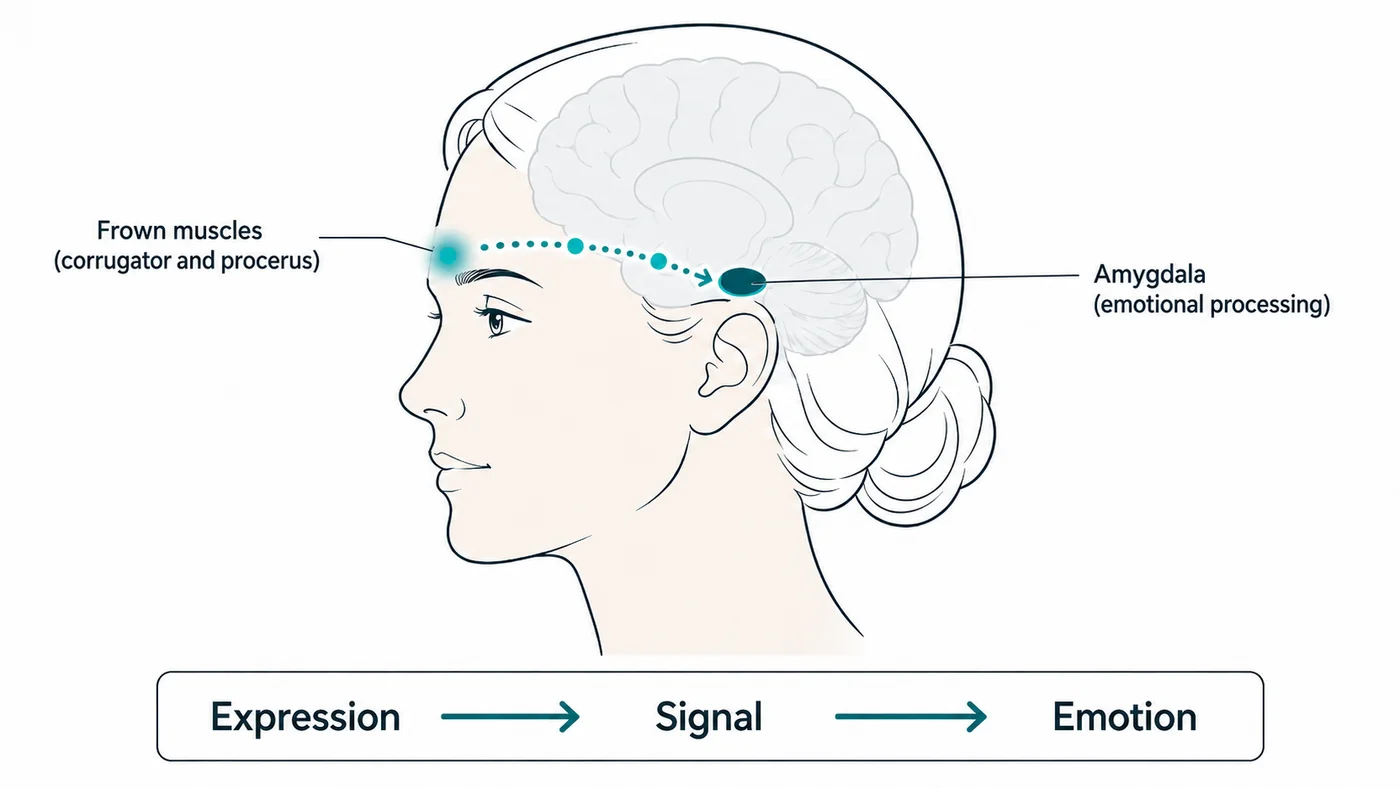
Put simply, when your brain receives fewer frowning signals, it may also experience less of the emotional reinforcement that those expressions normally provide.
What the Research on Botox and Mood Shows
This idea has been tested in several clinical studies.
In 2012, researchers at the University of Basel in Switzerland published one of the first randomized, double blind, placebo controlled trials in the Journal of Psychiatric Research. Patients with major depressive disorder who received Botox injections into the frown muscles experienced significantly greater improvements in depressive symptoms than those who received placebo injections.
Two years later, Dr. Eric Finzi and Dr. Norman Rosenthal, a psychiatrist and former researcher at the National Institute of Mental Health, published another randomized, double blind, placebo controlled study in the same journal. Once again, patients treated with Botox showed significantly greater improvements in depressive symptoms compared with placebo.
Since then, researchers have continued to study the link between Botox and mood. A 2021 systematic review and meta analysis, also published in the Journal of Psychiatric Research, evaluated the available randomized clinical trials and concluded that the evidence is promising, while emphasizing that larger studies are needed to understand which patients may benefit most.
Although scientists are still working out exactly how the effect occurs, the findings have been compelling enough to draw serious interest from psychiatrists, neuroscientists, neurologists, and aesthetic physicians around the world.
More Than Looking Better
For many people, Botox delivers an obvious confidence boost. Feeling refreshed, looking less tired, and seeing a smoother reflection can genuinely affect how you carry yourself in personal and professional settings.
But confidence may be only part of the story. This is where the possible emotional benefits of Botox come into focus. Researchers believe Botox may support emotional well-being through two complementary mechanisms:
- A psychological effect: feeling better about your appearance can naturally lift confidence and self-esteem.
- A neurological effect: relaxing the muscles responsible for frowning may reduce the negative facial feedback traveling to the brain.
This is also where the glabellar region matters most. A Botox treatment for frown lines targets the same corrugator and procerus muscles studied in the depression research, which is what ties the aesthetic result and the facial feedback mechanism together. Taken together, these effects may help explain why many patients report feeling not only more confident after treatment, but simply better overall.
Why Technique Matters
The goal of Botox is not to erase expression. The best results soften the muscle activity behind unwanted wrinkles while preserving your natural range of expression. Friends should notice that you look refreshed, not that you have had work done.
Botox at Avinity Health is always customized to your facial anatomy, your muscle movement, and your aesthetic goals. We believe strong results come from understanding facial anatomy, respecting natural expression, and building a plan that is individualized to you. If you are curious about the longevity of results, our guide on how long Botox results last walks through what affects duration.
The Bottom Line
Botox has earned its reputation as one of the most effective cosmetic treatments available. What makes it even more interesting is that researchers keep uncovering possible benefits that reach beyond appearance.
Multiple randomized clinical trials and systematic reviews suggest that relaxing the frown muscles may positively influence emotional well-being through the facial feedback mechanism. Research is ongoing, but the evidence has become strong enough to make this one of the most intriguing areas of modern aesthetic medicine.
It is important to be clear about the limits. Botox is not approved by the U.S. Food and Drug Administration (FDA) as a treatment for depression, and it should never replace appropriate mental health care. Avinity Health offers Botox for aesthetic purposes and does not treat depression.
If you are considering Botox, whether your goal is to soften wrinkles, prevent lines from forming, or simply look more refreshed, our team would be glad to help you build a personalized plan designed for natural, beautiful results. You can book a consultation whenever you are ready.